
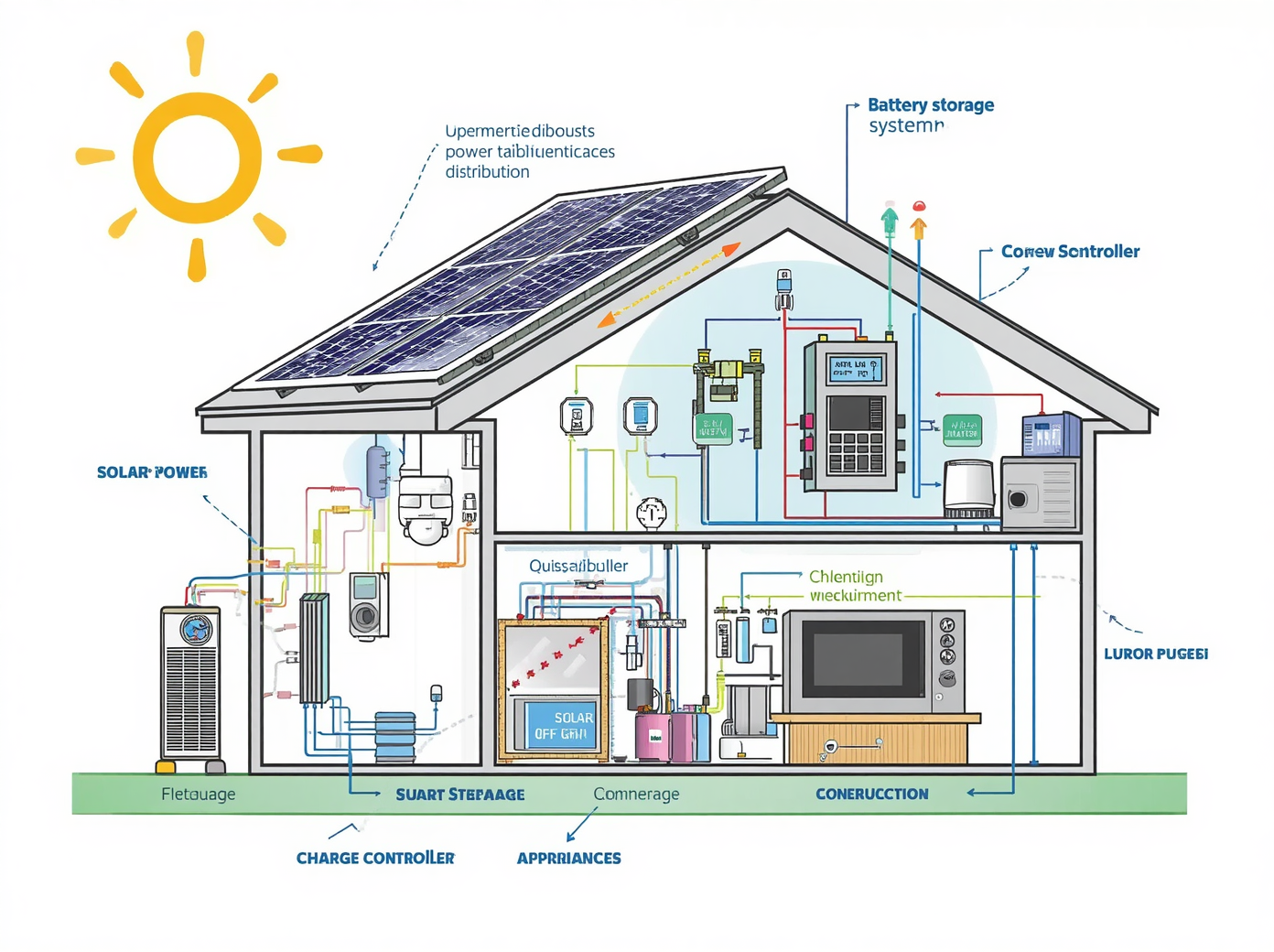
What will it take to power your house off grid
The national grid has failed consistently, and many households are no longer willing to depend on unreliable supply. The question is no longer whether to leave the grid, but what it actually takes to power a standard Nigerian home completely off-grid in 2026.
The home in question is a typical middle-class Nigerian residence: three bedrooms, a sitting room, kitchen, and basic utilities. The electrical load includes a refrigerator running continuously, a freezer, LED lighting across several points, two or three ceiling fans, a 1.5HP split-unit air conditioner in the master bedroom, a television, decoder, internet router, phone charging, and a water pump used occasionally. This type of home consumes between 15 and 25 kilowatt-hours (kWh) daily depending on usage, especially how long the air conditioner runs.
To operate independently of the grid, the system must be designed to meet this daily demand without interruption. That means generating sufficient power during the day and storing enough energy for night use and cloudy conditions.
The first requirement is solar panel capacity. To produce 15 to 25 kWh daily, the home needs approximately 6 to 10 kilowatts (kW) of installed solar panels. Nigeria benefits from strong sunlight, averaging 4.5 to 6 peak sun hours daily, which makes solar a viable solution if properly sized. In 2026, high-quality monocrystalline panels are the standard due to their efficiency and durability. Each 400-watt panel costs between ₦180,000 and ₦250,000. A system of this size requires about 16 to 20 panels, bringing the total panel cost to approximately ₦3.5 million to ₦5 million. Proper installation requires panels to be positioned at an optimal tilt angle and free from shading to maximize output.
The next critical component is the inverter. This is the system’s control center, responsible for converting the direct current (DC) produced by the panels into alternating current (AC) used by household appliances. For a home of this size, an 8kW to 10kW hybrid inverter is required. A hybrid inverter allows the system to manage solar input, battery storage, and generator backup seamlessly. In 2026, reliable inverters range between ₦800,000 and ₦1.8 million depending on brand and quality. Investing in a trusted inverter is essential because system stability depends on it.
Battery storage is the most expensive and most important part of going off-grid. Solar panels generate electricity during the day, but energy must be stored for use at night. A home consuming 15 to 25 kWh daily requires at least 20 to 30 kWh of usable battery storage. Lithium iron phosphate (LiFePO4) batteries are the preferred option because they last longer, tolerate heat better, and require minimal maintenance. A standard 48V 200Ah battery stores about 9.6 kWh. To achieve reliable overnight supply, at least three to four units are needed. In 2026, each unit costs between ₦900,000 and ₦1.4 million, bringing total battery costs to ₦2.7 million to ₦4.2 million. Cheaper battery options exist, but they degrade quickly and increase long-term costs.
Installation is another major consideration. A proper system includes mounting structures, wiring, protection devices, earthing, and labor. In Nigeria, professional installation for this scale ranges from ₦400,000 to ₦800,000. This is not an area to compromise. Poor installation leads to system inefficiency, equipment failure, and potential safety risks.
Even with a well-designed solar system, backup power remains necessary. Extended periods of low sunlight, particularly during the rainy season, can reduce solar output significantly. A 5kVA to 7.5kVA generator provides emergency support during such periods. In 2026, a reliable generator costs between ₦450,000 and ₦900,000. However, with a properly sized solar system, generator use becomes occasional rather than daily.
The total cost of powering a standard Nigerian home off-grid in 2026 falls between ₦7.9 million and ₦12.7 million. This includes solar panels, inverter, battery storage, installation, and backup generator. While this figure may appear high, it reflects a complete and durable solution designed for long-term use.
For comparison, many Nigerian households currently spend between ₦1.5 million and ₦2.5 million annually on diesel, generator maintenance, and grid electricity combined. Over time, these recurring expenses exceed the cost of installing a solar system. With solar, operational costs drop significantly after installation, and the system can last 10 to 15 years with proper maintenance.
A smaller system can be installed at a lower cost, typically between ₦2.5 million and ₦6 million, but such setups only support basic loads and may not handle air conditioning or heavy appliances effectively. Full off-grid independence requires proper sizing. Undersizing is the most common mistake and leads to poor performance.
The benefits of a correctly installed system are immediate and practical. The home runs continuously without dependence on the grid. Noise from generators is eliminated. Fuel expenses are reduced. Power becomes stable and predictable. Appliances last longer because they are no longer exposed to voltage fluctuations.
The decision to go off-grid is ultimately financial and strategic. It requires upfront capital, but it replaces years of unstable electricity and recurring fuel expenses with a single, structured investment. The system must be designed based on actual energy consumption, not assumptions. Every component must be properly selected, installed, and integrated.
Powering a Nigerian home off-grid in 2026 is entirely achievable, but it demands a realistic budget, proper planning, and professional execution. Anything less will fail. A correctly designed system will deliver consistent, reliable power for years. The grid is uncertain. Solar, when properly implemented, is not.